Feedback should reach the person who delivered the care.
Patients, relatives, carers and colleagues can recognise a named member of staff through a simple mobile journey. Individuals retain a useful feedback history, while service leaders gain a clearer view of the experiences being created across clinical and community settings.

Praise reaches the service. Too rarely, the person.
A patient may remember the support worker who noticed their anxiety, the nurse who made instructions understandable or the community colleague who treated their home with respect. Yet feedback often arrives later through a service survey, card or general inbox, attached to a ward, clinic or provider rather than the person who shaped the experience.
Staff lose specific examples of the care people valued. Leaders also lose role-level and team-level visibility across services that may be spread between hospital sites, clinics and people's homes, limiting the material available for recognition, reflection, supervision and local improvement.
Evidence that speaks your regulator's language
NMC revalidation, where applicable
The NMC Code
The primary value of Pulse in healthcare is staff recognition and service insight. For nurses, midwives and nursing associates, relevant feedback may also support reflection and revalidation. The registrant remains responsible for selecting appropriate evidence and completing every NMC requirement.
Written reflective accounts
A registrant may choose a relevant item as the starting point for reflection on practice, learning or an aspect of the Code.
Reflective discussion
Specific feedback provides grounded material for discussion, while the conversation itself must still meet the NMC's formal requirements.
Professional development
Recurring themes can help identify strengths and learning priorities without being treated as proof of clinical competence or completed CPD.
How feedback actually gets collected here
Approved staff cards
An authorised badge companion or take-away card lets patients and carers confirm the named person through its QR after an interaction.
Discharge and aftercare information
A Pulse insert gives patients or relatives time to respond once immediate instructions have been understood and they are ready to reflect.
Clinic departure points
An appropriately placed QR near the exit invites feedback after an appointment without interrupting clinical flow or compromising privacy.
Community visit materials
A card left after an agreed home or community contact provides a practical route where there is no reception desk or central feedback point.
From a helpful intervention to a lasting record
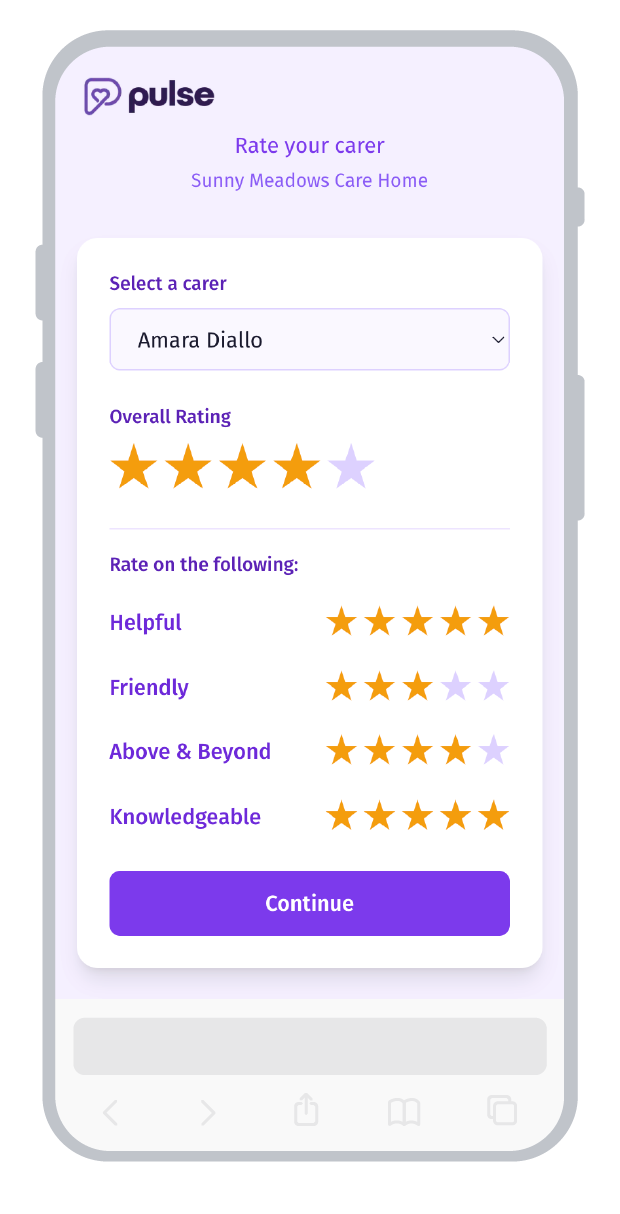
An outpatient healthcare support worker notices that a patient is uncertain about where to go next, walks them to the correct department and checks that their transport home is arranged.
Before leaving, the approved card opens four short prompts on the patient's phone. They confirm the colleague and record the reassurance they received.
That account becomes part of the worker's personal feedback history. The service lead also gains a clear example of how non-clinical support is shaping patient experience across the pathway.
What this looks like in practice
How recognition could travel across a distributed service
Imagine a provider using Pulse across outpatient departments and community teams. Patients and carers could recognise named staff for clear explanations, considerate support or effective coordination at the point those moments occur. Each colleague would build a personal history of feedback, while service leaders could compare themes across teams and locations. Applicable NMC registrants might select relevant entries for reflection, but Pulse would remain separate from clinical governance and would not complete revalidation for them.
Questions we're often asked
Whose perspective can be recorded?
Patients can respond directly where appropriate. Relatives and carers may contribute from their own standpoint or record what they observed during the care interaction. Colleague feedback can be included where the organisation permits it. The source of each perspective should remain clear.
How does Pulse sit alongside PALS, complaints and patient-safety systems?
It is a separate recognition-led channel. PALS or complaints, safeguarding, incident reporting, clinical governance, statutory reporting and formal patient surveys remain unchanged. Threshold controls can hold lower-scoring feedback for management review.
Is Pulse an NMC revalidation product?
No. Relevant Pulse feedback may be one source an applicable registrant chooses to reflect on, subject to NMC requirements and local policy. Pulse does not approve evidence, write reflective accounts or validate revalidation.
Build a clearer record of the care people value.
Give staff specific recognition and give service leaders a more useful stream of experience insight for reflection and improvement.