Better Social Value reporting starts with better evidence.
Pulse gives organisations a continuous evidence base built from real service interactions, helping turn everyday experiences into something that can be understood, reported and used with confidence.
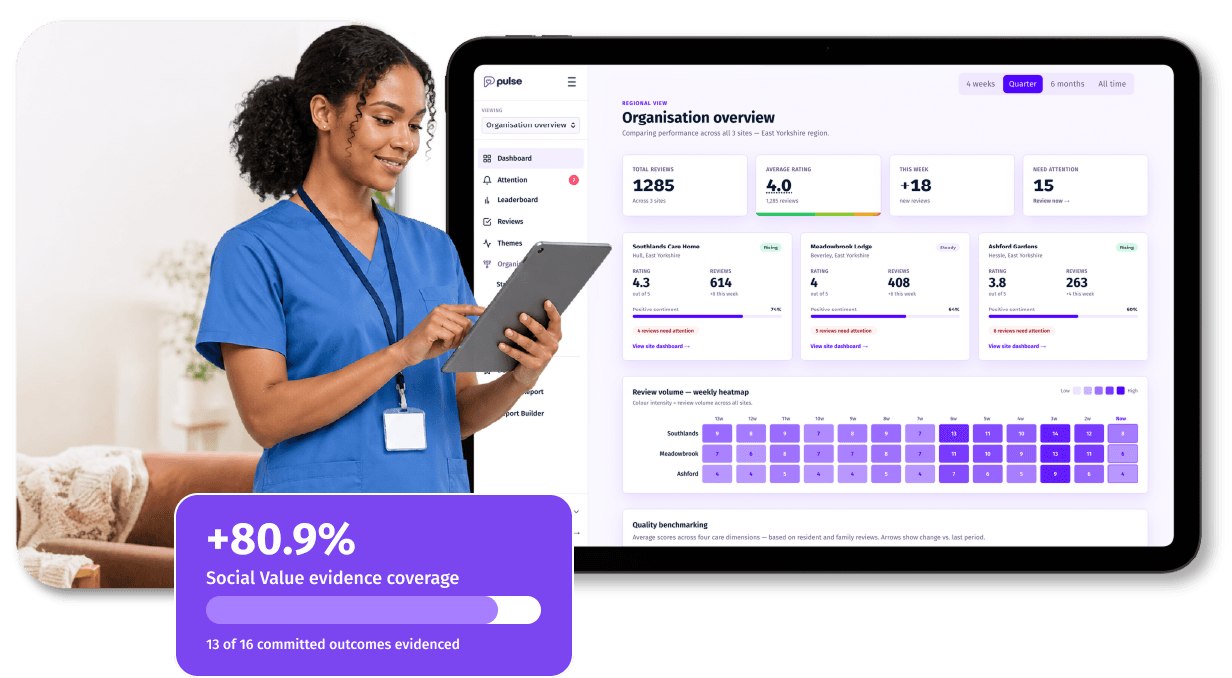
Social Value is judged on what you can evidence.
Social Value commitments increasingly shape procurement, contract delivery and renewal across publicly commissioned services. The challenge is not stating the ambition. It is showing what happened, who benefited and how you know.
Pulse turns everyday service interactions into a continuous evidence stream that is easier to use in bids, reporting and commissioner conversations.
Strengthen bids with evidence
Support tender responses with current, people-level evidence rather than relying only on policy statements and retrospective examples.
Evidence delivery as it happens
Build an ongoing record of recognition and service experience that can support contract reviews, commissioner conversations and renewal.
Cut the reporting burden
Capture evidence through everyday service delivery, reducing reliance on separate surveys, spreadsheets and manual collation.
Credible evidence depends on trusted data.
Pulse is built to protect the integrity, privacy and security of the data behind your evidence, so it can stand up to scrutiny.
Make Social Value easier to evidence, not harder to deliver.
Social Value can quickly become a box-ticking exercise when evidence is gathered after the fact. Pulse captures relevant people-level evidence through everyday service delivery, helping organisations build a clearer line from activity to outcome, impact and value.
That gives you a stronger evidence base for bids, reporting and the opportunities you want to compete for.
Capture what happened
Recognition and service feedback are recorded at source, linked to the people, place and experience behind them.
Structure the evidence
Pulse turns individual interactions into consistent, usable records that can be aggregated across teams, sites and services.
Build evidence of change
As evidence accumulates, organisations can investigate how recognition relates to people feeling valued, supported and engaged.
Connect it to wider performance
Bring people-level evidence alongside workforce stability, retention and service quality to build a stronger case for organisational impact.
Support credible valuation
Where the evidence is robust enough, it can support recognised Social Value methodologies, stronger reporting and more credible work-winning conversations.
Capture what happened
Recognition and service feedback are recorded at source, linked to the people, place and experience behind them.
Built to work with the Social Value approaches already in use.
Pulse does not replace established Social Value methodologies. It helps organisations build the people-level evidence those approaches often depend on, making it easier to support bids, report against commitments and demonstrate delivery with greater confidence.
UK Government Social Value Model
Used across public procurement to evaluate how organisations contribute wider social, economic and environmental value. Pulse can help strengthen the people-level evidence behind relevant commitments and contract reporting.
Social Value TOM System
A structured approach for setting, measuring and reporting Social Value through Themes, Outcomes and Measures. Pulse can provide evidence around workforce experience, recognition and service delivery that may support relevant measures.
HM Treasury Green Book
The UK Government's established approach to appraising and evaluating wider economic and social outcomes. It provides the basis for assessing impact properly before assigning financial value.
WELLBY
A recognised wellbeing methodology used to assess changes in life satisfaction and, where the evidence supports it, estimate their social value. For Pulse, the important point is not to assign a value to recognition itself, but to understand the outcomes that may follow.
NHS Social Value requirements
Social Value forms part of NHS procurement and provider-selection considerations. For organisations delivering commissioned health and care services, stronger evidence can help support procurement responses, contract delivery and commissioner conversations.
CQC and Ofsted are not Social Value frameworks. But the feedback, service experience and workforce wellbeing evidence Pulse captures can contribute to that broader quality and regulatory picture too.
Built on experience in measuring Social Value

Gerard Toplass, co-founder of Pulse, previously founded Pagabo and Loop, where Social Value measurement and evidence formed an important part of the wider work around public-sector procurement and impact.
Start with evidence. Understand the outcome. Measure the impact. Only assign value when the evidence supports it.
Pulse is developing the evidence base needed to better understand how recognition contributes to wellbeing, engagement and retention, and how those outcomes may be represented within established Social Value methodologies over time.
Build a stronger evidence base for your Social Value commitments.
Whether you're strengthening a tender, reporting against existing commitments or looking for a better way to understand the human impact of your services, Pulse can help make that evidence easier to capture.