Latus Group: Making service quality visible
How can everyday feedback become evidence of service quality? Latus Group is piloting Pulse to explore opportunities to win and retain customers, improve service delivery and recognise its people.

For Latus Group, service quality is shaped by thousands of individual interactions. The company delivers occupational health and workplace wellbeing services to employers across the UK, including in the care sector.
Its work happens through individual appointments, where staff expertise and small acts of care shape how customers experience the service. Yet much of that day-to-day quality is difficult to capture or demonstrate through periodic reviews alone.
Its Pulse pilot, starting in the care sector, explores how capturing these experiences can provide valuable evidence for customer relationships, continuous improvement and staff recognition. Latus wants to see whether feedback captured at the point of delivery can support new customer conversations and renewals, help teams resolve concerns sooner and improve service delivery. It is also testing whether the feedback gives managers a clearer way to recognise great work and support staff retention.
The problem
YODHA measures workforce health, but not how individual appointments are experienced. Praise often stayed in passing conversations and emerging issues could remain unseen until formally raised. Without a consistent record, Latus had less evidence to demonstrate service quality, resolve concerns early or recognise good work.
What Pulse is testing
Pulse captures quick, app-free feedback at the point of service, dated and linked to a named practitioner. Latus is piloting it alongside YODHA to see whether a continuous record helps prove quality, spot issues earlier and make individual contributions visible across teams and client sites.
Where it could make a difference
Inside the story
The missing layer
Latus Group supports more than 3,800 businesses across the UK. It delivers occupational health and workplace wellbeing services from offices in Hull, Manchester and Leicester into sectors including manufacturing, construction, transport, education, healthcare and social care. Its YODHA platform brings employee health, health surveillance and management data into a single connected ecosystem, giving employers oversight of workplace health that was previously spread across paperwork and periodic reporting.
That ecosystem answers what the data says about a workforce's health. It says nothing about how the service producing that data was experienced by the people on the receiving end. That is the gap Latus is now testing Pulse against, starting with its care-sector work.
The feedback that never becomes data
Latus delivers through individual appointments, thousands of them, in workplaces rather than clinics. A technician puts somebody at ease before a hearing test. A clinician explains what a result actually means rather than handing over a form. A team works around a shift pattern so a care home is not left short on a screening day.
The person on the other side of that appointment notices. The business rarely hears about it.
Rob Amies, Head of Service Operations at Latus Group, is responsible for how services are delivered across the business. His concern was not that the quality was absent, but that the evidence of it was being lost. Positive feedback existed in conversations, passing comments and thank-yous that never reached a system, never attached to a named individual and never accumulated into anything the business could measure. Emerging problems followed the same pattern in reverse, becoming visible only once they had grown large enough to be formally raised.
Why most feedback tools fail in this environment
Latus looked at the options available and found the same obstacle in most of them. Feedback mechanisms that depend on somebody downloading an app, creating an account or completing a lengthy survey do not survive contact with a busy care environment. Response rates fall, and what does arrive comes days or weeks after the appointment it describes, by which point the detail has gone and only a general impression remains.
Pulse takes a different approach. Feedback is captured at the point of the interaction, with no app to download and no account to create. Each response is structured against four themes, covering whether the interaction was friendly, helpful or knowledgeable, or went above and beyond. Every response is dated and attached to a named individual. The result is a record that works as recognition for the person who earned it and as data for the business at the same time.
Understanding service quality alongside YODHA
Fit mattered as much as function. YODHA already gives Latus and its clients oversight of employee health, health surveillance and management data, which is the clinical output of the service. Pulse sits alongside it and captures the delivery of that service: who provided it, how it was experienced, and whether that experience holds up across teams, locations and client sites.
For Latus's care-sector clients, that carries a commercial edge as well as an operational one. An occupational health contract is usually assured through service-level measures and periodic review. A continuous, attributable record of how the service was actually experienced is a stronger form of evidence than either.
What the pilot is set up to test
The pilot is deliberately narrow. It is set up to answer three questions rather than to demonstrate three benefits.
The first is recognition. Managers can only recognise what they can see, and where the evidence of good work never leaves the appointment, recognition depends on who happened to be in the room. Latus wants to know whether visibility of who consistently creates positive experiences changes how managers recognise and develop people. Gallup's longitudinal research found that well-recognised employees were 45 per cent less likely to have changed organisations two years later, which in a market competing hard for clinical staff is not a small margin.
The second is timing. A single piece of feedback is an anecdote. Hundreds of them, attributed and dated, should begin to show which individuals, teams and client sites are performing and where support is needed, early enough to act rather than react.
The third is evidence. Latus wants to establish whether a continuous record of how its service is experienced proves more useful, to the business and to its clients, than the periodic assurance it would replace.
Summary panel as text
The problem: YODHA measures workforce health, but not how individual appointments are experienced. Praise often stayed in passing conversations and emerging issues could remain unseen until formally raised. Without a consistent record, Latus had less evidence to demonstrate quality, resolve concerns early or recognise good work.
What Pulse is testing: Pulse captures quick, app-free feedback at the point of service, dated and linked to a named practitioner. Latus is piloting it alongside YODHA to see whether a continuous record helps prove quality, spot issues earlier and make individual contributions visible across teams and client sites.
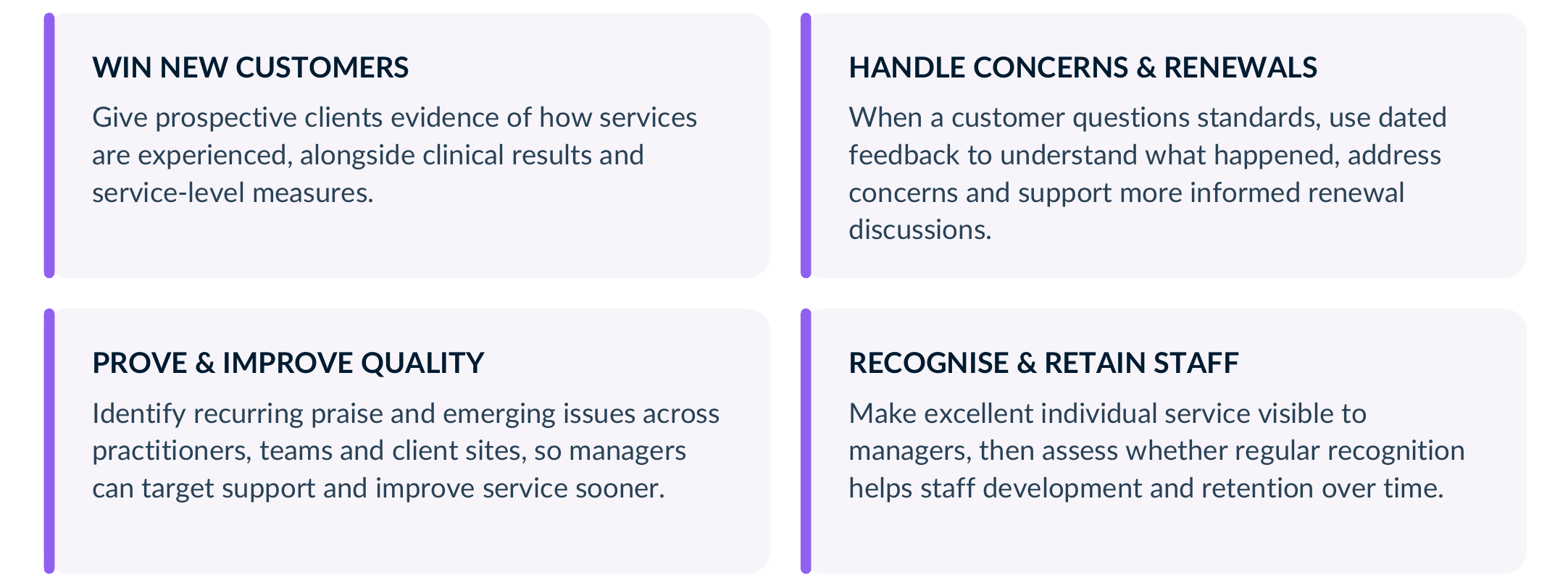
Win new customers: Give prospective clients evidence of how services are experienced, alongside clinical results and service-level measures.
Handle concerns & renewals: When a customer questions standards, use dated feedback to understand what happened, address concerns and support more informed renewal discussions.
Prove & improve quality: Identify recurring praise and emerging issues across practitioners, teams and client sites, so managers can target support and improve service sooner.
Recognise & retain staff: Make excellent individual service visible to managers, then assess whether regular recognition helps staff development and retention over time.